Showing posts with label 5th Grade. Show all posts

Book of the Year

 Today I wanted to share an end-of-the-year activity that my class is working on called the Book of the Year Project. For this project, students get to nominate their favorite book that they read this year, draw the cover of the book, and write an opinion piece explaining why the book is their favorite.

 
Step 1: Design the Cover
Most of the kids in my class love to draw, so to make this project a little more fun for them, I start by having them draw the cover of the best book that they read all year. I usually ask them to draw it on plain white paper in pencil and then I copy their drawings onto cardstock and have them color the copy in. That way I can laminate them and use them to decorate the room!

Here are some of the covers that my kids have drawn in the past:


Step 2: Project Cover Sheet
Once they have finished drawing and coloring in the cover of their book, I ask students to fill out this cover sheet that they will staple to the front of their completed project.


Step 3: Planning The Essay
Once students get to this step, they have already come up with three reasons that the book they have nominated is their favorite, so I give them the graphic organizer below to start planning. I ask them to find at least three supports for each reason, just like we did in all of the opinion pieces that we wrote this year. 


Step 4: Writing the Essay
For this step I have students use their completed graphic organizer and the guidelines for writing an opinion piece to write a first draft on loose leaf paper.


Once they have edited and revised, I give them the paper below to write their final piece, which they will publish for their classmates to read.


Step 5: Vote
Once everyone has completed this project, we have a day where students can read each others' essays and vote on the book of the year that they think is best using the ballot cards included in this product.


Step 6: Poster
I will place a drawing of the winning book on the poster template included in this product and hang it up in our classroom library.


If you would like to use this resource, you can find it in my TPT Store here.
0

Usage and Mechanics

Every year our school puts together what we call a "Literary Magazine" in which every single student gets to publish a piece of writing. This year, since we adopted Lucy Calkins and our kids have written so much the Literacy Team decided to have kids polish off their favorite pieces and submit them for the magazine. Of course, this meant that us teachers got to make sure that every single essay was perfect, which took forever, but it opened my eyes to something pretty important and it was actually kind of fun!

I gave my students back all of the writing that they have done this year and we were all impressed by just how much they have written. I think we counted that they had written at least ten five-paragraph essays! I told each of them to pick their favorite piece and then we went over some basics of editing and revising. 

MANY of the mistakes that my kids made were on things that I should have taught them this year. I am ashamed to admit that I did not really explicitly teach grammar a.k.a. usage and mechanics this year unless I noticed that everyone happened to be making the same mistake and gave an impromptu lesson. So, I decided that fourth quarter would be the perfect time to squeeze this in (especially since we already took our end of year writing assessment)!

I went all the way back to the first quarter standards and taught them how to use possessive nouns properly in their writing using this little packet that I created. (FREEBIE ALERT)

https://www.teacherspayteachers.com/Product/5th-Grade-Writing-Usage-Mechanics-Possessive-Nouns-3141372

Then, I had them check their writing to see if they made any possessive noun mistakes and I was so proud of them for identifying them, referring to what I called their "cheat sheet", and fixing them without my help! 

Because I was so happy with how this lesson worked out, I decided to keep going and this week we worked on the next standard: comparisons with adjectives and adverbs. You can see the "cheat sheet" below and click on it to grab the whole packet from my TPT store.

https://www.teacherspayteachers.com/Product/5th-Grade-Writing-Usage-Mechanics-Comparisons-With-Adjectives-and-Adverbs-3141359

I am hoping to get as many of these standards covered as possible in the next 6 weeks that we have left, so if you like these, stay tuned! I'm planning to post them one by one as I create them and then I'll bundle them all together and hopefully create a workbook to use throughout the entire school year next year.
0

Third Quarter is Over (What?!)

I can't believe how fast this year is flying by! (I say that every year, but this year truly feels like it has gone by faster than any of the others). Third quarter is officially over, spring break has come and gone, and our second to last round of report cards are done!

I'm not sure how things are done in other states, but in Virginia we teach new standards for the first three quarters and then, at the end of the third quarter, the kids take a cumulative assessment and we use the results to plan reteaching/test prep for the fourth quarter.

We just took our third quarter test on Friday so I figured I would share with you one of the things that I did to make test prep/review fun and meaningful!


Quizizz
 For the past year or so I have been pretty much exclusively using Kahoot! for review games, but I recently discovered Quizizz and am loving it so far! Here's a little tour of how it is different and why I think it is perfect for review/test prep:


There are also funny memes that pop up and tell them whether they got the question right or not My kids all said that the memes were their favorite thing about the game.

This is the best thing about Quizizz in my opinion! The day after they played my third quarter review game, I gave them printed copies of the questions and their own answers, marked correct or incorrect, and had them use their notes to fix any of the ones that they got wrong.

If you want to use the Quizizz that I created to review many (not all) of the standards that we have covered this year you can find it here.

Nonfiction: Autobiographies & Biographies
Since we are approaching the end of the year and many of my students (and I) have not read the two required Biographies/Autobiographies to complete our reading challenge, I decided to invest in some books that I thought they would be interested in.

One of my boys, who hardly ever reads books from start to finish, is obsessed with LeBron James. He talks about him all the time and has even started putting LeBron's name on his papers.


So, I bought the book I Am LeBron James and told him that I got it specifically for him and he read the entire thing in class that day. #happyteacher

https://www.thriftbooks.com/w/i-am-12-lebron-james_grace-norwich/8986068/#isbn=054567350X
Here are a couple of other books that my students were pretty excited about:
https://www.thriftbooks.com/w/messi-a-biography_leonardo-faccio/920682/#isbn=0345802691
https://www.thriftbooks.com/w/ronaldo-the-obsession-for-perfection_luca-caioli/710351/#isbn=1906850291

https://www.thriftbooks.com/w/breakaway-beyond-the-goal_alex---morgan/9540585/#isbn=1481451073 

https://www.thriftbooks.com/w/boy-tales-of-childhood-by-roald-dahl/271280/#isbn=014241381X
0

Literary Essay

Literary Essay
We are just about to finish up our third writing unit from Teacher's College/Lucy Calkins, so I wanted to share how it went, what we did, what worked and what (definitely) did not work!

This quarter we focused on writing Literary Essays, which, before working my way through this unit, I could not have explained to anyone! So, since I wasn't 100% sure what a Literary Essay was and I knew my students weren't either, we started by just reading a bunch of sample essays and discussing what they were.

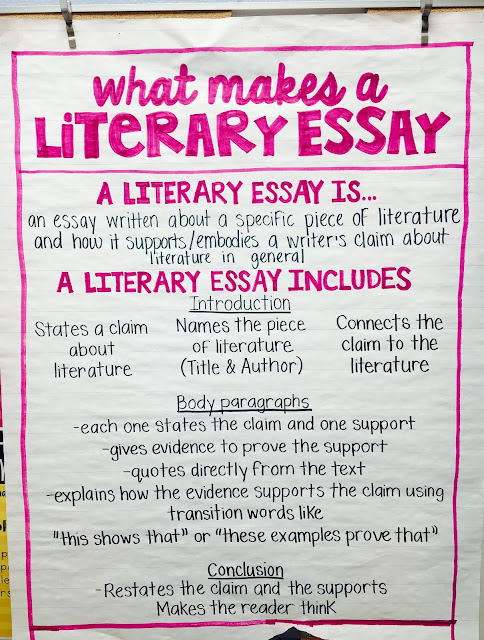
Our writing kit comes with access to several examples of Literary Essays written by students, so we read over a few of them and discussed our findings, and then I put together an anchor chart of all of the things we noticed (or that I wanted them to notice and they didn't).

For the first bend of this unit, instead of using an actual text, we watched the Panyee Football Club Video and used that as our "piece of literature". Although I think it was a bit confusing for them that we used a video in the first bend and then used text in the second bend, I do think that this was a nice way to start the unit because they didn't mind watching, re-watching, and analyzing bits of the video over and over again. 

After watching the video a few times, I asked them to look for common themes, lessons, character traits, etc... I emphasized that one way to come up with a claim is to pinpoint something in the text/video that you have seen before and we discussed how the characters worked hard like the characters in many different stories and movies, how people didn't believe in them at first which we see in a lot of stories, etc... Below is a list of all of the claims that we came up with:
After that, I had them pick a few claims and try out writing a thesis statement/lead/introduction (I'm trying to use all three terms so they know that they all mean the same thing). We used the graphic organizer below to do this and when students felt that they had one claim that they could write a strong thesis statement for, they chose that as the one that they would use to write the rest of their essay.
Once we all had our claims and thesis statements ready to go, we worked on collecting evidence from the video in order to create strong body paragraphs.

Finally, they wrote their own essays and I took home a stack of 36 papers ready to grade them all over the weekend. Unfortunately, however, when I started to read them, I noticed that more than half of both of my classes wrote summaries of the entire video instead of actual Literary Essays. They included quotes and plenty of details from the video, but they just did not seem to get that they were supposed to focus only on the parts of the video that supported their claim.

At that point I decided to create a checklist for writing a Literary Essay and I used it to score all of their essays. Before giving the essays back, I showed them the checklist and had them use it to grade two of the sample student essays that we had looked at at the beginning of the unit. 


 I think that seeing what I expected to be included in each section of the checklist as well as being able to read samples of text that included all of the necessary components really helped them to figure out what they needed to do. I gave them more time to edit and revise using the checklist and their second drafts were much better!

For the second bend, they were able to choose their texts and they completed most of the writing process on their own with guidance when needed or requested. I hung up the chart below and had them stick a sticky note with their name on it to whichever step they were on each day.


Our team agreed that the suggested texts for this bend were a little too long and complex for our students, so we decided on four short stories: (We just googled these titles and found PDFs of them online that we printed for the kids) 

Everything Will Be Okay by James Howe
Fly Away Home by Eve Bunting
The Marble Champ by Gary Soto
Birthday Box by Jane Yolen*
*Disclaimer: I cried when I read this one aloud to the class

We did have to go back and review transition words and when/how to use them in the middle of this bend, so I made this chart as a reference tool:

Now they are all typing up their essays and I will be grading them (hopefully) over spring break!
If you are interested in using any of my anchor charts and/or graphic organizers that I created for this unit you can grab them here!

Growing Words
I have not been doing the best job of keeping up with our Growing Words (a.k.a. Greek & Latin prefixes, root words, and suffixes) this quarter so this week we dove back in to that starting with the Root Words Aqua- and Hydr-, which both mean water.

On day 1 I introduced the root words using my little presentation that you can grab here.
And for the rest of the week they followed the routine that they are used to & used some worksheets that are included in that product to further explore those root words.

Guide Words
Last week I posted all about my Word Reference Materials unit which worked out really nicely for most of my kids, but I have a few who are really struggling with answering questions about guide words. They just can't seem to wrap their mind around the fact that they need to alphabetize and check if a word comes after the first guide word and before the second guide word. 

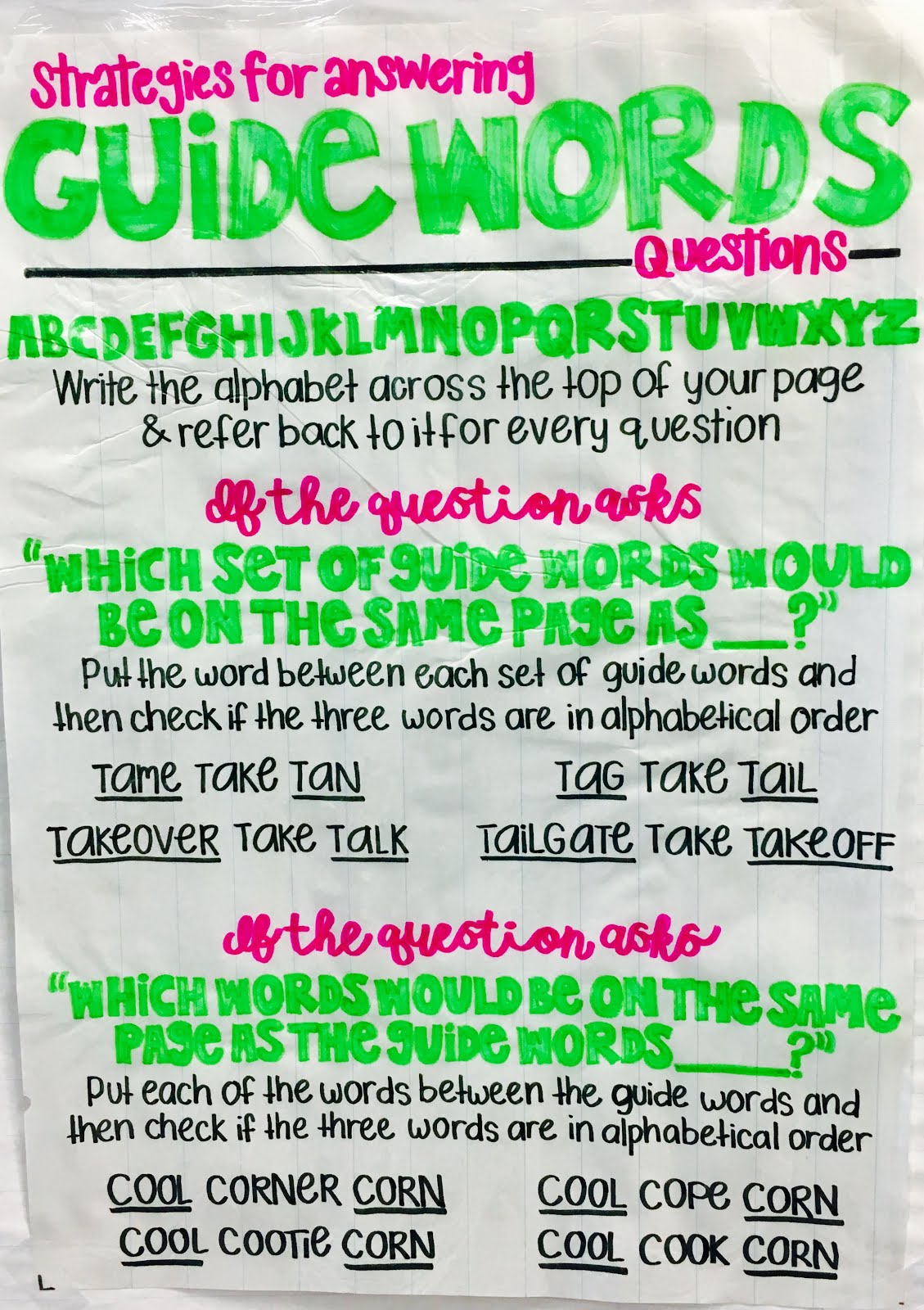
I've been trying to give them some strategies to tackle these questions like writing the alphabet at the top of their page, putting the words in between the guide words and checking the alphabetical order, etc... I even made them this little anchor chart to refer back to, which sadly got a little crumpled in the laminator.


Here is a digital copy in case you are interested in using it in your classroom!

We practiced using these strategies with a few questions in a presentation that you can grab for free below!

https://www.teacherspayteachers.com/Product/Guide-Words-Practice-3053297
1

Word Reference Materials

We just finished up a two week unit on Word Reference Materials that I wanted to share with you all!
We started the unit off by talking about what Word Reference Materials are and then taking a closer look at dictionaries, glossaries, and thesauruses (that's a fun one to say). We discussed what each one is, looks like, and the information that it provides us with.

Next we completed an interactive notebook page/sort of all of the different features of each word reference material. This was a great opportunity for me to correct mistakes and talk to kids about misunderstandings one-on-one as I walked around the room checking their sorts.


Once we got the basic information down about word reference materials we took a closer look at each one and worked on using guide words and understanding the use of multiple-meaning words from the dictionary. We completed a few practice question together and then students got some independent practice using the worksheets included in this unit.

Finally, I had them complete a set of 25 task cards using the type of questions that they will see on their quarterly tests and end of the year SOL.


(I may add on a few more guide words practice pages to this unit for students to continue practicing throughout the rest of the quarter because that turned out to be a lot harder than I expected!)

0

The Research Based Argument Essay a.k.a. Opinion Writing

We just finished up our second Lucy Calkins unit! This one was, "The Research-Based Argument Essay", which is quite a mouthful so I just call it "Opinion Writing". This unit was really fun because the kids got to pick sides and argue, which are two of their favorite things to do! :)

The first bend of the unit had all of us pick sides on the great "chocolate milk debate". We all decided whether or not chocolate milk should be served in schools and then used articles that came with the unit to read arguments for and against our claims. We worked on taking notes while researching and then writing essays at the end of the unit.


After we finished bend I (which took forever because winter break happened right in the middle of it and then there were two separate weeks of testing that got in the way) we moved on to bend II where the kids got to pick their topics, do the research on their own, and write another essay. This one was tough to manage so I figured I'd share some of the things I did to save my sanity while trying to coach 36 kids through the writing process.

Choosing a Topic
 Our fifth grade team had a little debate over whether to give students a list of choices for their topics and then provide them with the resources they would need to do research OR to leave it open for them to come up with their own topic and do the research themselves. I decided to leave it up to them just because I thought it would be more fun and I was interested in seeing what they would come up with, but our other fifth grade teachers stuck with a list of topic choices and I don't think that they found it was any less fun!

I decided that the best way for me to help them through the opinion writing process would be for me to write my own essay alongside them, so I decided to write an argument for changing the school calendar to a year round school schedule. (Many of them booed when I told them my idea but some were convinced by the end of this thing!)

Research
I let my kids do most of their research on their own and, while it was awesome to see some of the evidence they came up with, there were definitely some issues with doing it this way. They were distracted by advertisements (especially pictures of Donal Trump) and some found articles that were not from "scholarly" sources. SO, next year I think I may try doing this the other way and letting them choose from a set of topics that I have already done the research for.

I created a couple of graphic organizers to help kids take notes and keep track of their sources while they were doing research and modeled using them for my own topic before sending them off on their own.


Planning
Once they had at least three sources, I asked them to start thinking about their top three reasons to support their argument. I had them complete a planning page (below) and start putting in evidence from their research. (Again - I modeled doing this for my essay before having them do it on their own)


First Draft
My kids are the worlds slowest typers, so when they are drafting, I find that it's best to let them get all of their thoughts down on paper first and then I have them type up their writing to make editing easier. Our school does have personal google accounts for each of them, but it takes them SO LONG to find their login info, type it in, retype it in because they forgot one letter, etc... so I just made a class google account that we all get on at the same time and made folders for my different classes.

 (The only issue with this was that, toward the end of the unit, they figured out that they could get on each others' documents and mess with them so I had to threaten them with being sent to the principal and possibly suspended if I caught them on someone else's doc.)

Editing
Once they started turning in their drafts it was a bit chaotic because some were done and ready to edit and others were still typing, so I used google slides to keep track of everyone and started to do editing meetings with the ones who were done.
 
I kept track of who needed to attend which meetings just by writing on their rubrics that I used to score their first drafts. After they attended a meeting I would put a check and the date next to it.
 

For my editing meetings I focused on one feature of opinion writing at a time. For example, I got all the kids who didn't write leads, or did but needed to improve them, together and gave them instructions for writing a strong lead that I took straight from the learning progression for grade 5. I would then have them read a mentor text with a strong lead and identify the features that the writer included (e.g. stated their claim, listed reasons that they would develop later, explained why their topic mattered, etc...). Then I would model writing a lead for my own paper before having them work on editing theirs on the computer.

Before publishing their final drafts, I had them use a checklist to make sure that they included all of the necessary components of an opinion writing piece. The checklist is one that I created based on the Lucy Calkins learning progression for opinion writing but with more kid-friendly language and some features that I thought needed to be added in or removed (see bottom right page in picture below).


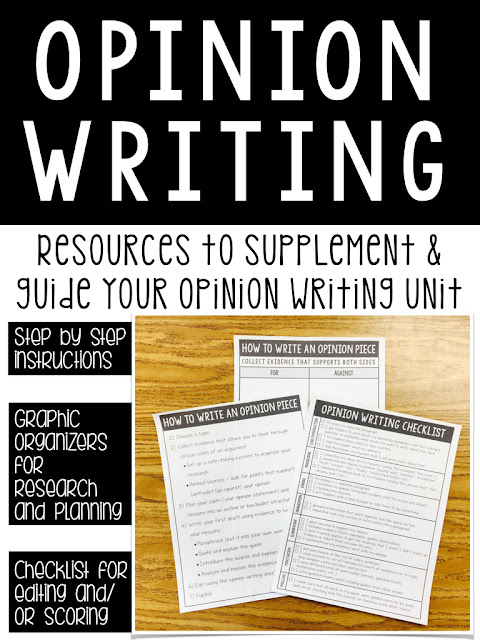
So anyways, that's how I made this unit work for my kids and I'm sure it will look different in every classroom depending on how many kids there are, how familiar they are with Lucy Calkins' style of teaching, how much technology is available, etc... but I just thought I'd share in case anyone could use some guidance or just a general overview of this unit. If you want to grab the planning pages and checklists that I used you can grab them from my TPT store here or by clicking on the picture below. Enjoy!

https://www.teacherspayteachers.com/Product/Opinion-Writing-Resources-3008859

2
Back to Top